
Arbitrage Betting in New Zealand: Where the Numbers Actually Come From
 Available in US
The idea sounds clean: back every outcome of an event at prices offered by different bookmakers, and walk away with a profit no matter which result lands. The marketing surrounding it borrows the language of certainty — “sure bets”, “risk-free wins”. The arithmetic behind those two words is real, and so are the constraints that sit underneath it: how thin the typical margin is, how fast a bookmaker spots the pattern, and what New Zealand law actually allows a person sitting in Auckland or Wellington to place those bets with.
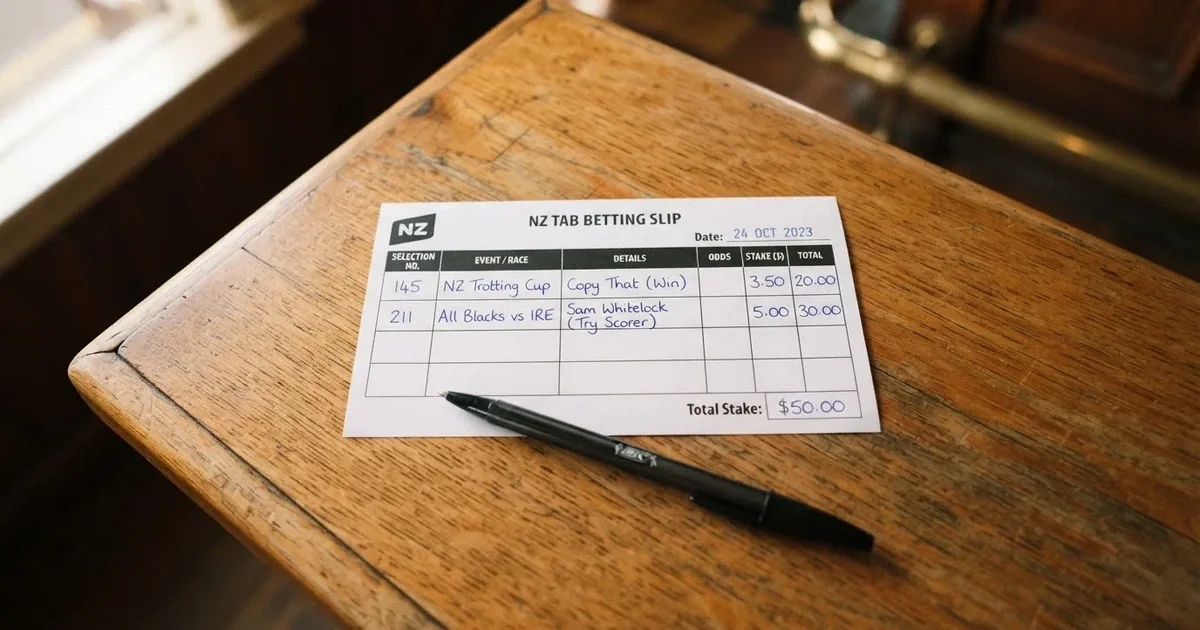
The angle of this page is cost. Arbitrage betting costs the bettor money, time and standing with the bookmaker long before it pays out. Three things set the frame. The Racing Industry Act 2020, as amended in 2025, leaves TAB NZ and Betcha as the only operators lawfully allowed to take online sports and racing bets from people in New Zealand — a structure that, on its own, makes the multi-bookmaker format of arbitrage illegal in practice. The 2012 study the academic literature keeps citing (Franck, Verbeek and Nuesch) puts the median return below 1.2% on 98% of opportunities, which means the technique only pays at scale. And every bookmaker in the world reacts to it, which makes longevity the largest of all the costs.
30 October 2026 — current as of that snapshot, with figures cross-checked against TAB NZ’s terms and the Racing Industry Act 2020 as in force after 28 June 2025.
Table of Contents
- What Crypto and Anonymity Actually Change for an Arbitrage Bettor
- Predictions, Strategy and the Bets a Punter Plans in Advance
- The Markets, the Odds and What a Bet Slip Actually Holds
- The New Zealand Landscape in 2026: TAB NZ, Betcha and a Field of Unlicensed Brands
- The Core of Arbitrage Betting: Where the Word Comes From
- Regulation, Monopoly and What the Racing Industry Act 2020 Actually Says
- Responsible Gambling in an Arbitrage Context
- Operator Reviews
- Frequently Asked Questions
What Crypto and Anonymity Actually Change for an Arbitrage Bettor
A punt chasing arbitrage often lands on crypto-first bookmakers because those brands do not run a traditional bank-rail account check. Roobet operates under a Curaçao licence (OGL/2024/687/0427) held by Raw Entertainment B.V., registered in Curaçao with company number 157205. BetNinja holds an e-gaming licence from the Union of the Comoros. These are real licences issued by real regulators. Neither gives its holder any right to take bets from people in New Zealand. The law there puts the liability on the operator, not the player: section 19(4) of the Gambling Act 2003, inserted in 2025, says an individual cannot be convicted for placing a bet with an offshore operator that is in breach of section 74AAA. That phrasing is what DIA’s enforcement record reflects; it is not a green light to bet offshore.

The appeal of the crypto route is procedural, not legal. Coin deposits settle faster than a card deposit, which matters when the window between spotting an opportunity and placing the bet is the entire profit. KYC is lighter at signup on some crypto-first brands, and the deposit trail does not read as “gambling” on a bank statement. None of this changes the regulatory frame in New Zealand, and none of it changes what the offshore operator does when its trading desk flags the account. A bookmaker that closes accounts for arbitrage does not start by reading the deposit method; it reads the bet pattern.
The honest list for a New Zealand resident is short. Roobet, BetNinja, Golden Panda, Rabona (the sixth sportsbook from Soft2Bet, launched 23 December 2019), 22Bet, Ivibet — every one of these is unlicensed in New Zealand under the post-amendment regime. The Department of Internal Affairs told unlicensed providers serving New Zealand to withdraw with immediate effect when the amendment came into force. A crypto deposit does not change the message on that withdrawal letter, and the local harm-minimisation framework — deposit limits, time-outs, self-exclusion across brands, the helpline at 0800 654 655 — does not extend offshore. Dia’s own warning to New Zealand residents points to operators in jurisdictions with minimal consumer safeguards that may not return unspent credits and may not pay out large wins. Crypto does not solve any of those risks. It changes the rail to a faster one and leaves the destination the same.
A practical note on record-keeping. Bookmakers asked to clarify the source of funds tend to find a stablecoin deposit harder to read than a debit card one. A few offshore brands operate on the assumption that crypto deposits sit outside any reporting framework. A New Zealand resident working with the IRD on a gambling dispute is in a weaker position when the only record is a wallet address and a casino’s internal ledger. Crypto is useful when speed is the binding constraint. It is not a privacy tool against anyone with the legal authority to ask.
Predictions, Strategy and the Bets a Punter Plans in Advance
The strategy around arbitrage betting is statistical before it is operational. The pure form requires three or more bookmakers offering prices on the same event that diverge enough that the implied probabilities over all outcomes add up to less than 1. The academic summary of how often that happens is a 2012 study (Franck, Verbeek and Nuesch) that found 98% of arbitrage opportunities yield less than 1.2% on turnover. The remainder sit between 1.2% and, in rare cases, the high single digits. The 98% figure does not say arbitrage betting does not work; it says a stake that returns 1.2% over a long settlement cycle produces the same economic outcome as a high-yield savings account with a much shorter settlement window. The bettor who turns 1.2% per round on a portfolio of $50,000 wins roughly $600 a month before any account-level friction — and every friction, from the withdrawal fee to the currency conversion, eats into that number.

Forecasts and tipster services sit at a different layer. Betcha runs a Playbook with tips and match analysis, plus a Bet Social feed where punters chat, follow tipsters and share bets or pools. The forecast is not the same object as the arbitrage. A forecast is one opinion on one outcome. An arbitrage is a layout across two or more opinions on every outcome. Services that sell “sure bet tips” are usually selling forecasts dressed in arbitrage language, and the bettor who acts only on those alerts will not clear the spread between a single-bookmaker tip and the multi-bookmaker setup an arbitrage needs.
The working sequence for an arbitrage bettor runs in four steps. First, an algorithm or a sharp human spots the spread — usually on a market where one bookmaker has moved a line late or one bookmaker has set a price on a fast-changing live event. Second, the bettor checks that every bookmaker in the layout will still accept the stake at the quoted price, and that the cumulative implied probability still leaves a positive return. Third, the bettor splits a fixed bankroll across the outcomes in proportions that match the odds. Fourth, the bettor settles and waits. Step four is where most of the friction lives. A bookmaker that notices the pattern across step three may void the bet, cap the stake at a fraction of what was asked, or slow the withdrawal long enough to make the bettor question the next round. A bettor running a system across multiple operators tends to learn step four from the operators themselves, not from a strategy guide.
The functional constraint, the one that decides whether any system survives, is stake sizing. An arbitrage bettor is not betting to win; the bettor is betting to expose enough turnover at the right margin to make a small percentage meaningful in dollar terms. That arithmetic scales linearly with bankroll. A bettor with a $2,000 bankroll clearing 1% on a well-laid portfolio earns $20 across many bets. A bettor with a $200,000 bankroll on the same portfolio earns $2,000 — and attracts a categorically different response from the bookmakers involved. The strategy is not a strategy at all at small scale; it is a costly hobby that occasionally produces a small profit.
The Markets, the Odds and What a Bet Slip Actually Holds
An arbitrage opportunity exists when the odds cover all mutually exclusive outcomes of an event and their implied probabilities add up to less than 1. The “implied probability” is the bookmaker’s view, expressed as a number, of how likely each outcome is. A price of 2.00 means the bookmaker thinks the outcome has a 50% chance — a fair coin, in other words. Two 2.00 prices on opposite sides of a market give the bookmaker a margin of zero in theory and a margin of 100% in bookmaker language, because the bookmaker keeps the stake whatever happens. Two prices of 1.90 and 1.90 give the bookmaker the same thing: an overround of about 5.26% on each side, totalling 5.26% as the margin for the market as a whole. The bookmaker’s profit is the gap between what was staked and what was returned across all winning bets, and the gap is the margin.
For a Two-way market at decimal odds 1.90 and 1.90 — an example, not a quoted price — the payout share works out to 1 ÷ (1/1.90 + 1/1.90) = 1 ÷ (0.5263 + 0.5263) ≈ 0.95, or 95%. The margin is 1 − 0.95 = 0.05, or 5%. That means the bookmaker keeps about 5% of every unit staked on this market across all winning outcomes. An arbitrage bettor is looking for a layout that pushes the implied probability below 1 — which means the combined bookmaker margins are below 0 — and pockets the negative margin as profit.
The market the bettor works in is wider than football. TAB NZ’s published betting rules cover Win, Place, Each Way, Quinella, Exacta, Trifecta, First Four, Double, Treble, Daily Double, Running Double, Quaddie and Big6, and Multis and Same Game Multis. Same Game Multis are a single event’s legs stitched into one bet — a newer format that opened a fresh set of layouts for arbitrage hunting. TAB NZ has both fixed-odds and tote (pool) bets in market; a multi-bookmaker arbitrage across a fixed-odds market and a tote pool looks tempting on paper, but the betting rules of a tote pool do not pin a price at the moment the bettor places the bet — the dividend is set when the pool closes — which makes the tote unusable in a classical arb. The bookmaker leg of the arbitrage has to come from a fixed-odds book.
Stakes come with their own ceiling. TAB NZ’s own terms set stake and odds limits on its markets, and the same kind of limit sits inside every offshore bookmaker’s terms. Golden Panda publishes dedicated Sports Terms and Conditions that cover fixed-odds betting, Combo Bets, the Bet Builder feature, live scoreboards and broadcasts, and stake and odds limits. Every operator in this market has the same ceiling somewhere in its fine print — a ceiling that becomes the binding constraint on the high-stake end of an arbitrage layout. A bettor who has worked out a layout that pays 1.2% but requires a $20,000 leg on a niche market will often find the actual clearance is $500. The 1.2% return on a $500 layout is not a strategy.
The New Zealand Landscape in 2026: TAB NZ, Betcha and a Field of Unlicensed Brands
The shape of the New Zealand market has been settled by statute since 28 June 2025. Section 74AAA of the Racing Industry Act 2020, inserted by the Racing Industry Amendment Act 2025, says no person other than TAB NZ may offer racing betting, sports betting or other racing or sports betting to a person in New Zealand, regardless of where the offeror or the punter is resident or incorporated. There is no licence to apply for and no licence register for betting because there is only one lawful operator. New Zealand law does not geo-block offshore sites; it puts liability on the operator.
| Brand | New Zealand status | What the operator’s own terms say on the page’s subject |
|---|---|---|
| TAB | TAB NZ brand — the only lawful online bookmaker | Racing and sports fixed-odds and tote bets; Win, Place, Each Way, Quinella, Exacta, Trifecta, First Four, Double, Treble, Quaddie and Big6; Same Game Multis; stake and odds limits in terms |
| Betcha | TAB NZ brand — the only lawful online bookmaker | Daily Toolbox with odds boosts and insurance; Bet Social with tipsters and shared bets; Playbook with tips and match analysis |
| Glorion | Not licensed in New Zealand | Live chat and email support; customers 18 and over |
| BillyBets | Not licensed in New Zealand | Decimal (2.00), American (+100) and Fractional (1/1) odds formats; cashback and reload bonuses on sports; five-level VIP programme |
| Roobet | Not licensed in New Zealand | Curaçao licence OGL/2024/687/0427 (Raw Entertainment B.V.); crypto deposits accepted |
| 22Bet | Not licensed in New Zealand | Curaçao licence 8048/JAZ (TechSolutions Group N.V.); singles, accumulators, systems and chains; live betting with real-time odds and scores |
| Rabona | Not licensed in New Zealand | Curaçao licence; launched 23 December 2019 as the sixth sportsbook of Soft2Bet |
| Golden Panda | Not licensed in New Zealand | Dedicated Sports Terms covering fixed-odds, Combo Bets, Bet Builder, live scoreboards and broadcasts, and stake and odds limits |
| BetNinja | Not licensed in New Zealand | Union of the Comoros e-gaming licence; casino-first brand with a sportsbook section |
| FunBet | Not licensed in New Zealand | Football, ice hockey, American football, basketball, volleyball, tennis, rugby, baseball; live betting; 24/7 bookmaker |
TAB and Betcha are the two online brands of one operator group. The partnership with Entain, signed in 2023, runs the TAB business under a 25-year agreement that gives Entain a 50/50 share of gross profits, with at least $150m a year going to TAB NZ for the first five years, and Entain pledged a one-off $100m payment to the racing sector. The two brands are not rivals to each other on price or product; they target different demographics from the same book. A New Zealand resident who wants the local protection framework — the helpline, the self-exclusion that applies across both brands, the deposit limits in the TAB app — has only those two brands as the lawful path.
Every other name in the table above does not have a New Zealand licence. Glorion, BillyBets, Golden Panda and FunBet name no licence that applies in New Zealand. Roobet names a Curaçao licence held by Raw Entertainment B.V. (registration 157205, Korporaalweg 10). 22Bet names a Curaçao licence (8048/JAZ) held by TechSolutions Group N.V. Rabona names a Curaçao licence under its Soft2Bet operation. BetNinja names a Union of the Comoros e-gaming licence. None of these is a New Zealand licence; the New Zealand statute says no licence matters short of TAB NZ. For an arbitrage layout that needs three or more bookmakers, the lawful roster is two names long, and they are the same operator.
A New Zealand punter who runs an arbitrage layout across TAB and Betcha is, in effect, punting against the same trading desk twice. The prices diverge in places — Betcha’s boosted-odds segment and TAB’s stable line on the same fixture can produce a thin spread — but the divergence is internal to one operator’s pricing policy, not a market disagreement. The opportunity that ends in guaranteed profit at scale, the classical arb, is structurally absent under the monopoly.
The Core of Arbitrage Betting: Where the Word Comes From
Arbitrage has a precise meaning in finance: the simultaneous purchase and sale of an asset on different markets to profit from a tiny difference in price. The same arithmetic shows up in betting when one bookmaker quotes 2.10 on Team A and another quotes 2.10 on Team B for a match. A bettor who stakes in proportion — $50 on A with one bookmaker and $50 on B with the other, say — collects $105 from the winning leg and recovers the full $100 stake from the losing leg, with $5 as profit and zero exposure to which side wins. The phrase “sure bet” is the marketing label; the technique is the layout.
The origins are not in finance textbooks. The bettor who arbitrages a sports event is reading two bookmakers’ opinions of the same outcome and finding the gap. Bookmakers do not have one opinion each; each bookmaker has a marginal view that pushes its price half a tick above or below the consensus. The gaps are usually too narrow to clear the round-trip cost. Sometimes a bookmaker is slow to update after team news — a star halfback pulls out of a rugby test twenty minutes before kick-off and most books have already moved, but one has not. Sometimes the gap comes from a model error, the kind of human-plus-software drift that an algorithm catches faster than a human does. Either way, the gap closes within minutes in liquid markets; the window is wider in smaller markets — futures, novelty bets, racing at regional tracks — where the bookmakers’ models disagree more often and for longer.
The arbitrage bettor’s cost stack is what kills the model at retail scale. Each leg of the layout pays the bookmaker’s margin on that leg’s stake; the profit is the excess of payout over total stake after the margin is wiped from each side. Most retail accounts pay a withdrawal fee, and most retail accounts face a non-zero chance the bookmaker limits the stake on one leg while accepting the other two. The bettor whose layout relies on a $20,000 leg and gets a limit of $2,000 has not run an arb — the bettor has run a directional bet on the side that landed.
A related variant — sometimes called a “Dutch” book or “scalping” — is the case where the bettor lays a price at a betting exchange. The New Zealand retail market has no licensed betting exchange. The arbitrage that opens up between a bookmaker’s back price and an exchange’s lay price is structurally not available to a New Zealand punter under the post-amendment regime. What is available is the cross-bookmaker layout between TAB and Betcha, which is internal to one operator and behaves more like promotional pricing than arbitrage.
A note on the language. The word “sure” is doing a lot of work in the marketing. The 2012 study puts 98% of opportunities at under 1.2%, which is a one-sided bet on price, not a guarantee of return. The technique is profitable on average, in batches large enough to smooth the variance, and only if the bookmakers do not notice. The fraction of bettors for whom the technique produces a net positive year is small; the fraction of accounts on which the technique is run for more than a few months without being limited or closed is smaller again.
Regulation, Monopoly and What the Racing Industry Act 2020 Actually Says
New Zealand is the clearest possible version of a regulated market: one licensed operator, one statute, one regulator. The relevant frame is the Racing Industry Act 2020, as amended by the Racing Industry Amendment Act 2025 (which took effect on 28 June 2025), with the Department of Internal Affairs (DIA) as the regulator under the Gambling Act 2003. The amendment did not regulate betting — it cornered it. There is no licence to apply for because the law does not contemplate another operator.
The change of 28 June 2025 is not a clarification. It is a prohibition. Section 74AAA now reads: no person other than TAB NZ may offer racing betting, sports betting or other racing or sports betting to a person in New Zealand, regardless of where that person is resident or incorporated. The “regardless of where” wording is the part that closes the standard geo-arbitrage that some offshore operators used to run on. DIA told unlicensed providers serving New Zealand to withdraw with immediate effect when the amendment came into force. The framework is operator-side liability, not player-side liability; section 19(4) of the Gambling Act 2003 (inserted in 2025) says an individual cannot be convicted for placing a bet with an offshore operator in breach of section 74AAA. The penalty for the operator that serves a New Zealand resident is not stated in the section, and no prosecution of an offshore bookmaker was found in public records. The honest description is that the law targets the operator and DIA warns the player; no published penalty for a player was found.
A separate act — the Online Casino Gambling Act 2026 — licenses online casino gambling only. TAB NZ winning the right to apply for a casino licence does not extend the betting monopoly. Greyhound racing is closing in stages from 1 August 2026, and from that date offshore operators may not take bets on greyhound races either. A New Zealand punter betting offshore on greyhounds after 1 August 2026 is engaging with an operator that has just lost one of its product lines, which is a separate consideration from the betting prohibition.
What may and may not be bet on. TAB NZ takes fixed-odds and tote (pool) bets. No lawful New Zealand betting exchange exists and spread betting is outside TAB NZ’s sports-betting definition. The racing codes are thoroughbred, harness (trots) and greyhounds (closing from 1 August 2026). Bets on politics and novelty markets are not established under the act. The ban covers events held inside and outside New Zealand. Virtual sport is treated by the 2026 online casino law as casino gambling, so a TAB NZ virtual sports product falls outside the betting monopoly — a clean example of how the two regimes are bolted together without overlapping. Whether esports betting is “sports betting” under the Racing Industry Act is not established; TAB NZ’s published betting rules cover sports and racing definitions that have not been updated to include or exclude esports.
Player protection. The age for TAB NZ betting is 18. Betting under 18 is an offence under section 89 of the Racing Industry Act 2020. Land-based casinos in New Zealand are age 20 — these are separate regimes and must not be merged into one age statement. A TAB NZ account requires a verified New Zealand address and ID. TAB NZ lists deposit limits, time-outs and self-exclusion in its apps, with the exclusion applying across both TAB and Betcha. TAB NZ pays a Problem Gambling Levy of 0.74% of its gross proceeds, in force from 1 July 2025 to 30 June 2028. There is no single national online-betting exclusion register; the register that the casino law will require is for online casinos only and does not extend to betting accounts. Help is the free Gambling Helpline (0800 654 655, text 8006) and Safer Gambling Aotearoa.
Advertising. The Advertising Standards Authority’s Gambling Advertising Code applies to betting advertisements. Ads must not target children (under 14) or young people (14 to under 18), judged by context, appeal and expected audience — the code treats an audience as significant for rule purposes if 25% or more of the audience is young people, where accurate data is available. Ads must not encourage harm and must be truthful with terms available. There is no New Zealand equivalent of a “whistle-to-whistle” ban. TAB NZ runs bonus-bets promotions; no New Zealand rule on bet-bonus size or wagering terms was found, so any quote on bonus terms sits inside TAB NZ’s own terms.
Tax. For the player, Inland Revenue guidance says recreational gambling winnings are generally not taxable and prize money from TAB horse, dog and trotting races is not taxable. A person who bets as a business is a different case and the relevant guidance is general information rather than tax advice. Operator side: TAB NZ pays the Problem Gambling Levy. Overseas operators supplying New Zealand residents pay an online gambling duty — 12% of profits since 1 July 2024, rising to 16% from 1 January 2027. A duty being payable does not make an offer lawful under section 74AAA, and writing that a duty payment shows an offshore bookmaker is legal is an error. The point-of-consumption charge on offshore racing and sports bets ceased on 30 June 2026.
Offshore providers. The DIA position is direct: an overseas bookmaker taking racing or sports bets from a person in New Zealand is breaking New Zealand law. New Zealand does not block bookmaker sites at the network layer. The Department has not stated a penalty for the player; the statute targets the operator. The consumer frame is unkind — minimal consumer safeguards at the offshore end, possible refusal to return unspent credits, payout disputes on large wins with no escalation path under New Zealand law. The honest summary: TAB NZ and Betcha are the only lawful option, with New Zealand harm-minimisation tools, regulator oversight and a complaints framework; offshore is unlawful for the operator to serve New Zealand, with no New Zealand complaints route, DIA’s stated risks, and limits or closures possible from the bookmaker side.
Responsible Gambling in an Arbitrage Context
Arbitrage betting has its own responsible-gambling profile, separate from a punt placed for fun on a Saturday race. The bettor is sizing stakes to clear a margin, not to enjoy a contest; the betting volume is high relative to bankroll, and the wins are small relative to stakes. Any sign that the wagering has moved from a profit system to a need is a sign to step back from the algorithm and treat the activity as what it is — high-turnover gambling with a small expected return.
TAB NZ, the only licensed retail brand in New Zealand, publishes the safer-gambling tools its app supports. The TAB – Racing & Sports Betting app, first released on the New Zealand App Store on 8 September 2014 under the seller name New Zealand Racing Board, lets a punter set deposit limits, take a time-out or self-exclude. The same exclusion applies across both TAB and Betcha, which means setting it once covers both lawful online brands for the New Zealand punter. The help line is the free Gambling Helpline (0800 654 655, text 8006), available to anyone in New Zealand. Safer Gambling Aotearoa is the funded prevention service. The list of tools in the app is short by international standards — no reality check, no time-on-site display in the public terms reviewed here — but the harm-minimisation framework in the statute is the most direct in this part of the editorial brief.
Outside the licensed brands, the responsible-gambling frame is weaker. Offshore brands named in this article — Glorion, BillyBets, Roobet, 22Bet, Rabona, Golden Panda, BetNinja, FunBet — do not extend the New Zealand harm-minimisation framework. Glorion’s stated support channel is live chat or email; the brand’s own terms mark it as a customer-facing business for adults over 18. The brand names no New Zealand regulator, no New Zealand exclusion register, no New Zealand helpline. The same is true of the others, in different shapes: each points to its own regulator in Curaçao, the Union of the Comoros, Costa Rica (the Tobique Gaming Commission in the case of RoyalistPlay and Rooster, which share an operator-company registration with Novatrix SRL, registration number 3-102-893958), and each runs its own complaint and exclusion process in those jurisdictions. The escalation path for a New Zealand punter who has a dispute with one of these operators is not local.
Two operational notes for anyone running a multi-bookmaker layout. The first is that self-exclusion is per-brand, and is most often set up at the customer-service layer. A punter who uses four offshore brands and self-excludes from two still has the other two as a route — which makes the layout harder to control from a harm-minimisation point of view than a single-bookmaker punt. The second is that the patterns automated limiters look for — high stake size, low margin wins, frequent withdrawals — overlap with the patterns an arbitrage book places automatically. A bettor flagged for responsible-gambling reasons on a bookmaker running an arbitrage layout is being flagged for the same data the bookmaker’s trading desk will eventually flag for trading reasons. The two are not the same problem, and the actions the punter takes in response are different, but the data is shared.
For someone whose betting has shifted from a system of work into something else, the path is not different in a New Zealand arbitrage context than in any other betting context: stop, talk to the helpline, use the self-exclusion tools that exist under the regulated brands. The arbitrage framing does not change the recommendation.
Operator Reviews
TAB — the only lawful online racing and sports bookmaker in New Zealand
The price on a TAB NZ market is set by the TAB NZ trading desk and then by the tote dividend when the pool closes. TAB NZ takes fixed-odds and tote bets on the racing codes (thoroughbred, harness, greyhound with greyhound closing from 1 August 2026) and on a full sports menu. The published betting rules name Win, Place, Each Way, Quinella, Exacta, Trifecta, First Four, Double, Treble, Daily Double, Running Double, Quaddie and Big6, and Multis and Same Game Multis. Stakes are subject to TAB NZ’s own stake and odds limits; no statutory per-bet cap sits above the operator terms.
The user-side frame is the only one of its kind in New Zealand. The TAB app carries deposit limits, time-outs and self-exclusion that apply across TAB and Betcha in one go. The New Zealand Gambling Helpline (0800 654 655, text 8006) sits in the app’s help layer. A verified New Zealand address and ID is the entry ticket, and the age floor is 18. TAB NZ has the regulator, the complaint path, the harm-minimisation tools and the local payment rails a person in this market has no alternative route to.
For arbitrage specifically, the verdict is structural. A punter who wants to lay out an arbitrage across the lawful New Zealand market is laying out across one operator — the same trading desk, with the second brand a different front on the same risk. The classical multi-bookmaker arb does not exist in the lawful New Zealand market because the lawful New Zealand market is one operator. The verdict on TAB as a betting destination is the verdict on the only destination available: it is the only one, it does what it says it does, and any advantage in the multi-brand layout it offers sits in marketing and pricing exceptions rather than in independent price discovery.
Betcha — the second online brand of TAB NZ, tuned for a younger crowd
Betcha is one of two online brands of TAB NZ — the same operator group, the same racing and sports betting rights under section 74AAA of the Racing Industry Act 2020, the same Entain partnership that runs the business. The product is built differently from the main TAB site. The daily Toolbox offers odds boosts and insurance on bets that do not land — the bettor takes a refund on a single losing leg if it meets the toolbox conditions. Bet Social is the social layer: chat, follow tipsters, share bets or pools. The Playbook carries tips and match analysis. The bettor choosing between TAB and Betcha within New Zealand’s lawful frame is choosing between a stable racing-and-sports book with deep markets and a youth-skewed product with a heavier marketing layer.
The relevant fact for an arbitrage hunter is that Betcha is not a second bookmaker. The trading desk, the risk profile, the ownership and the racing-and-sports betting rights are the same as TAB. The boosted-odds segment is the only segment that produces spreads between the two brands, and the boosted prices are the same operator’s choice to lend a margin to one event over another. There is no independent price discovery on the New Zealand lawful side at any level of the layout.
The verdict is the same in shape as the TAB verdict, with a different product layer. For a New Zealand punter who wants the local protection framework and a friendlier product, Betcha is the entry point. For a punt that wants an arbitrage edge across independent books, Betcha is not a separate book — and the page does not rate it as one.
Glorion — overseas customer support outside the New Zealand frame
Glorion’s own description is a customer-support business for adult players. Support is live chat or email, customers are 18 and over, and the brand names no licence that applies in New Zealand. There is no New Zealand regulator reach, no New Zealand exclusion register, and no path to local dispute resolution through the Department of Internal Affairs’ local framework. The brand’s name reads as a small-to-mid-scale operation; the absence of a local licence is consistent with a brand whose customer base sits elsewhere.
For a New Zealand punter reading this page, Glorion is a brand that is not licensed in New Zealand. Any review of it for arbitrage purposes is necessarily at a remove: the prices, the markets, the limits and the exclusion rules are not local; the harm-minimisation framework is not local; and the bettor who opens an account is engaging with an operator that has been told by DIA to stop serving New Zealand residents. The verdict is the verdict on the structural position: not licensed in New Zealand, no local escalation path, and any punt above trivial stake size must be weighed against the unavailability of New Zealand complaints routes if a payout fails.
BillyBets — three odds formats, a coin shop and a five-tier VIP
BillyBets offers three odds formats out of the box — Decimal (2.00), American (+100) and Fractional (1/1) — and covers the sports betting core: pre-match and live markets, multi-leg bets, and a bet builder on the events that support it. The sports side carries cashback and reload bonuses; the coin shop exchanges coins earned by depositing, betting, tournaments and challenges into free bets and free spins; the VIP programme has five levels. The setup reads as a mid-market European-licensed sportsbook-and-casino stack with no local licence for New Zealand.
For an arbitrage layout that needs three or more bookmakers, BillyBets is one of many overseas books a New Zealand punter has considered. Its pricing on the events it covers sits inside a Euro-currency base; the conversion to NZ dollars carries a small mark-to-market cost that eats into thin margins. The five-level VIP ladder is a retention mechanism, not a price advantage — high-tier perks tend to be personalised rather than priced. The verdict is the one that fits the structural position: a legal bettor has no reason to be on this page looking at BillyBets. A New Zealand punter using BillyBets is engaging with an unlicensed operator, and the cost of that choice sits outside the betting math.
Roobet — Curaçao-licensed crypto sportsbook with a Kiwi-facing API
Roobet operates under Curaçao licence OGL/2024/687/0427, held by Raw Entertainment B.V., registration number 157205, Korporaalweg 10, Curaçao. The brand is one of the larger crypto-first sportsbooks and its main acceptance is bitcoin, ether and stablecoins for both deposit and (where it offers withdrawal) for settlement. The sportsbook covers the standard European menu — football, basketball, tennis, ice hockey, American football — plus the live menu that crypto punters use for in-play arbitrage, where the latency advantage of a coin deposit becomes operationally useful.
For arbitrage specifically, the appeal is the rail, not the licence. A Curaçao licence gives Roobet no right to take bets from people in New Zealand, and DIA’s existing communication with Roobet-style operators is the immediate-withdrawal letter that followed the 28 June 2025 amendment. The crypto deposit does not change that letter. A New Zealand punter betting with Roobet is betting with an operator in breach of section 74AAA: no New Zealand complaint path exists, and payout and limit risk sit with the operator.
22Bet — broad market reach with a Curaçao foundation
22Bet is a Curaçao-licensed bookmaker (8048/JAZ) under TechSolutions Group N.V., covering singles, accumulators, systems and chains, and a live betting product with real-time odds and score updates. The breadth of the market menu is one of its main draws — football, basketball, tennis, ice hockey and a long tail of smaller sports. The pricing sits in the middle of the European-licensed cluster; the limits and bonus terms are mid-market; the brand names no New Zealand licence. The product is a useful leg in an arbitrage layout in markets where New Zealand had offshore licences available.
The verdict in this brief is the one this market sustains: a brand with broad coverage and Curaçao licence, in a country where Curaçao does not give access. A New Zealand punter considering 22Bet as an arbitrage leg is the same structural bettor who is considering Roobet. The math at scale works only if the operator does not notice, and the operator’s trading desk is the same desk that closes the account when it does.
Rabona — the sixth Soft2Bet sportsbook, launched in late 2019
Rabona launched on 23 December 2019 as the sixth online sportsbook of the Soft2Bet group. Curaçao-licensed; the same parent group that runs several of the brands a New Zealand punter has seen in commercial channels. The site’s product mirrors a Soft2Bet template — sportsbook, casino, live dealer, virtual sports — and the difference between this brand and its siblings is mostly in the marketing layer and the bonus structure rather than in the pricing engine.
The verdict reads the same as the verdict on the wider Soft2Bet cluster in this brief. Rabona is not licensed in New Zealand and DIA’s notice to unlicensed providers covers it. The 2019 launch date is a brand-age marker that affects retention and bonus terms; it does not change the structural position for a New Zealand punter. A New Zealand punter using Rabona is on an unlicensed book, and the book’s size is no defence against the limits and closures that follow a flagged pattern.
Golden Panda — explicit sports terms that put stake and odds limits in writing
Golden Panda publishes dedicated Sports Terms and Conditions covering fixed-odds betting, Combo Bets, the Bet Builder feature, live scoreboards and broadcasts, and stake and odds limits. The transparency on limits is the most useful feature of Golden Panda’s own page for an arbitrage hunter. Most offshore books leave limits to the customer-service layer; Golden Panda names them in the rule set. The brand itself sits outside the New Zealand licence frame and the underlying licence that Golden Panda operates under is not a New Zealand licence.
For a New Zealand punter, the verdict is the structural one and the brand-level transparency does not shift it. The page here carries the transparency point because it is what differentiates Golden Panda from its peers in this brief — explicit limits in the rule set is something a punter can expect from every brand, and Golden Panda is one of the few that says so plainly. The bettor who picks Golden Panda for that reason is still picking an unlicensed book in a market that has told the book to stop serving New Zealand.
BetNinja — Union of the Comoros licence, casino-first with a sports section
BetNinja operates under a Union of the Comoros e-gaming licence and is, by its own structure, a casino brand with a sportsbook section. The sports menu is narrower than the rest of this brief — the casino floor dominates the site. The Comoros licence gives BetNinja no right to take bets from people in New Zealand. The customer base is international; the local protection frame is absent; the local complaint path is absent.
For a New Zealand punter, BetNinja is a brand on the far end of a punt — far enough that the calculation behind an arbitrage layout needs either a tail sport the rest of the panel does not list, or a heavy live-bet focus that BetNinja’s sports menu makes thin. The verdict is that this is a brand that does not fit the New Zealand punt in a structural sense, and the page mentions it because a punter who has seen the name in commercial channels will look for an honest position on it.
FunBet — a 24/7 bookmaker on a broad sports menu
FunBet’s sportsbook covers football, ice hockey, American football, basketball, volleyball, tennis, rugby and baseball, with live betting and a 24/7 bookmaker. The menu is broad, the live product is on, and the brand names no licence that applies in New Zealand. The 24/7 framing means a customer-service layer that is live around the clock, useful when the live-bet layout fails at 3 a.m. and a stake needs to be queried.
The verdict is again the structural one. FunBet is in the comparison because a New Zealand punter has likely encountered it in search, and its limits and market breadth place it next to its peers. None of those facts change the frame: FunBet is not licensed in New Zealand, the harm-minimisation framework is not local, the complaint path is not local. A New Zealand punter running an arbitrage layout that includes FunBet is one structural breach away from a New Zealand-resident ban on offshore betting, and one automated-limit decision away from a stake cap on the leg the layout depends on.
Frequently Asked Questions
Does sports arbitrage betting work?
The arithmetic is real: a layout across all mutually exclusive outcomes with implied probabilities below 1 produces a profit no matter which side wins. In practice the typical return is below 1.2% on 98% of opportunities measured in one 2012 academic study, which means the technique only produces meaningful net gains at scale. Bookmakers limit or close accounts that trade in patterns arbitrage demands, and that side-effect is a recurring long-term cost. The math works; the system does not survive long enough to be a system, in most cases, before the bookmaker reacts.
How to arbitrage bet?
The steps are: scan multiple bookmakers for the same event, find a set of prices whose implied probabilities for all outcomes add to less than 1, split a fixed bankroll across the outcomes in proportions that match the prices, place the bets before the prices move, and settle. Most arbs close within minutes in liquid markets. Few retail bettors sustain the workflow for long because every leg of the layout goes through a different account that can be limited mid-layout. The sustained version needs automation, bankroll depth and a low-friction payment rail on every account in the chain.
How is the return on a bet worked out from the stake and the odds?
Return is stake times the decimal odds for a winning single bet; net profit is stake times (odds − 1). A combination bet multiplies the odds of each leg into one price and pays the same way. A decimal odds of 2.10 on a $100 stake returns $210 (the $100 stake plus $110 net profit) on a win. The arithmetic is the same on every bookmaker; the difference from bookmaker to bookmaker is the margin the bookmaker keeps across all winning outcomes.
What is the bookmaker’s margin and how can it be seen in the odds?
The margin is what the bookmaker keeps of every unit staked on a market across all winning outcomes. For a two-way market with decimal odds 1.90 and 1.90 the implied probabilities are 1/1.90 and 1/1.90, which sum to about 1.0526; the payout share is the inverse of that sum, about 95%, and the margin is 1 − 0.95, or 5%. A lower margin means the bookmaker takes less; a higher margin means more. The margin is the silent number inside every set of prices, and an arbitrage is the rare case where the sum of margins across bookmakers is below 0 — the bettor pockets what the bookmakers collectively ought to have kept.
Which bookmaker may lawfully take sports and racing bets in New Zealand?
TAB NZ and its online sister brand Betcha are the only two online brands of one operator group lawfully allowed to take online sports and racing bets from people in New Zealand under section 74AAA of the Racing Industry Act 2020, in force since 28 June 2025. There is no licence to apply for; the Department of Internal Affairs told unlicensed providers serving New Zealand to withdraw. New Zealand’s protection framework — deposit limits, time-outs, self-exclusion across brands, the Gambling Helpline at 0800 654 655 — sits with those two brands. Other brands reviewed on this page are not licensed in New Zealand.
Written by the editors at Nzbookmakers.